At the corner of Boulevard Nice and Avenue Mohamed Sijilmassi, a seafood boil lands on the table in a plastic-bib kind of way, loud and steamy and meant to be eaten with your hands. A few streets away, on Rue Goulmima, people stand at a tiny counter late into the night over bowls of mussels in spiced tomato sauce, while the traffic on Boulevard Ghandi keeps moving and the minaret of the Hassan II Mosque hangs in the distance like a fixed point. Bourgogne is Casablanca without the varnish: not a postcard district, not a showcase, but a place where the city does its daily work and lets you watch.
What Bourgogne is known for
Bourgogne is known, above all, for being normal. That sounds faint praise until you spend time here and realise how rare normality is in a city that visitors often meet through its landmarks alone. This is the residential middle of Casablanca, the part guidebooks tend to skim past and Casablançais take for granted. It sits in the centre-west, bounded by the Atlantic and the Hassan II Mosque to the north, El Hank and El-Hajajma to the west, Boulevard de Bordeaux and the medina fringe to the east, and Gauthier and Racine across Boulevard d'Anfa to the south. That position is the whole point: close to the mosque, the coast, the towers and the city centre, but still rooted in the everyday grain of the city.
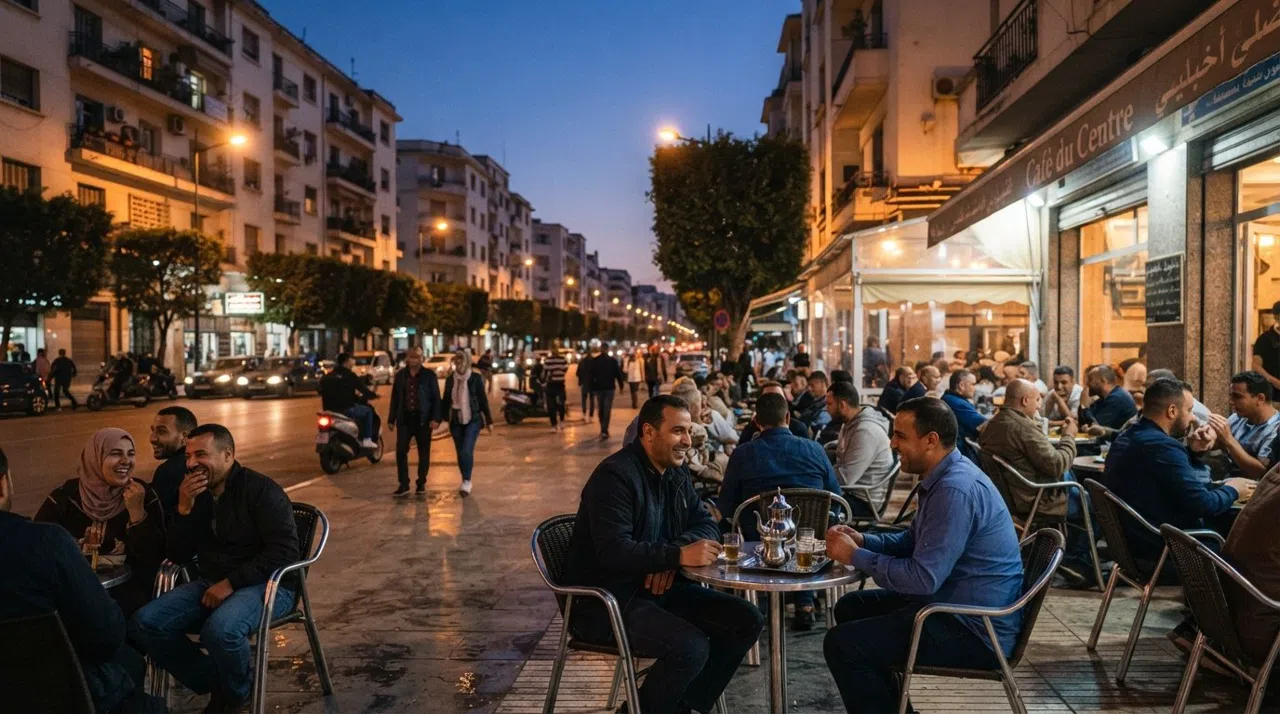
The neighbourhood was laid out at the tail end of the 19th century and first settled by French, Italian and Spanish families. You can still read that layered beginning in the small colonial houses tucked behind newer apartment blocks, in the Art Deco doorways that survive between pharmacies and phone shops, in the broad plane-tree boulevards that soften the traffic. Bourgogne has never been a polished district, and that is part of its appeal. The pavements are cracked, the shopfronts are practical, and half the ground floors are everyday necessities rather than lifestyle brands. But the place is alive in a way that glossy neighbourhoods often are not. Families, retired civil servants, students and shopkeepers share the same streets. Wealth and modest means live door to door. Men argue football over mint tea on café terraces at any hour. The hiss of an espresso machine and the call to prayer drift through the same air.
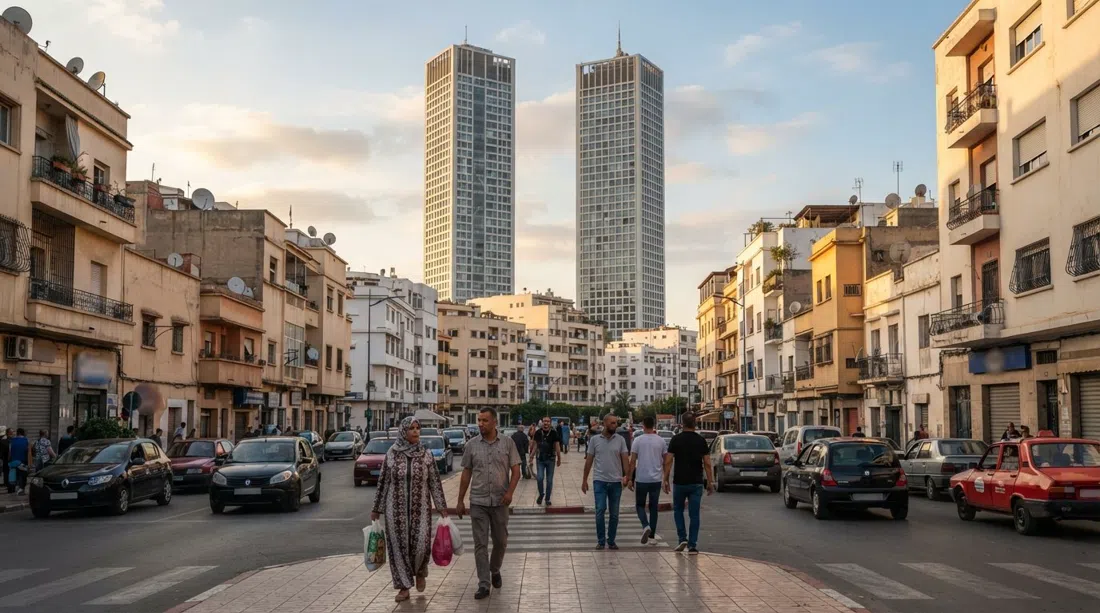
The neighbourhood’s visual anchor is the Twin Center at the southern gateway, Ricardo Bofill’s 115-metre twin towers at the Zerktouni junction. They mark the point where Bourgogne meets the city’s more polished southern edge. Northward, the Hassan II Mosque rises from the shore, visible from much of the neighbourhood and close enough to make staying here feel practical rather than symbolic. Between those two landmarks runs ordinary Casablanca: markets, pharmacies, corner cafés, and a city that works for a living.
Where to eat & drink
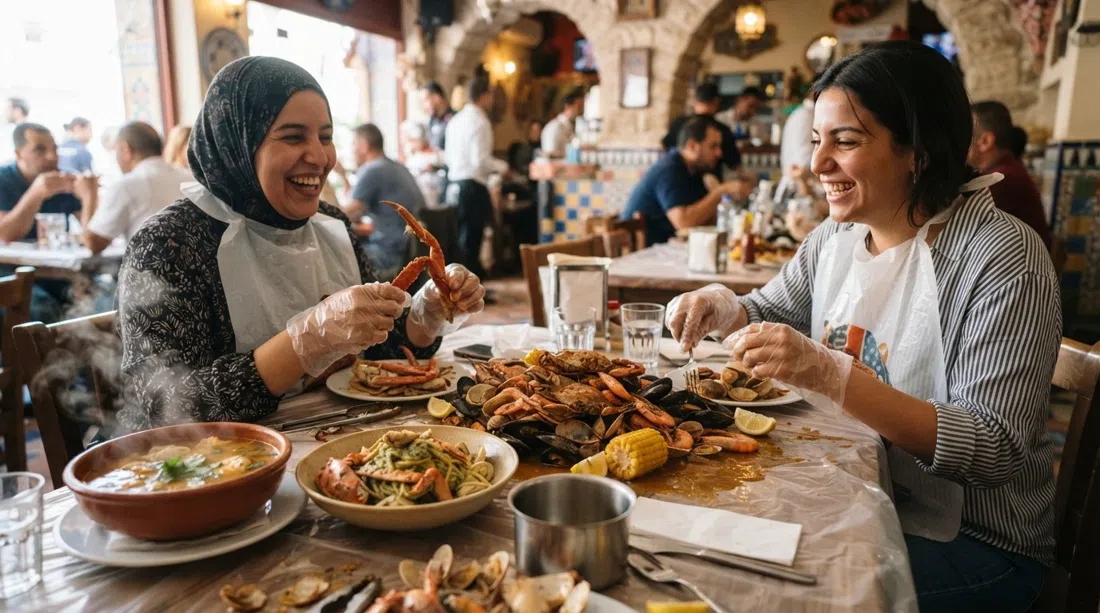
Eating in Bourgogne means eating like a local: casually, affordably, and without any concern for décor. The neighbourhood’s signature is seafood, and it tends to arrive in the sort of places where the table is secondary to the food. On the corner of Boulevard Nice and Avenue Mohamed Sijilmassi, Hello Crab does a Louisiana-style seafood boil from around 380 dirhams for the table, along with crab-pesto pasta and a fish soup for 50. It is hands-on, noisy, and exactly the sort of dinner that leaves the table looking as if a small storm has passed through. That is the point.
A few streets away, on Rue Goulmima, G Simple Fish is the kind of place that tells you a neighbourhood is still being lived in rather than performed. It is tiny, standing-room only, open until the small hours, and the local move is m9ila — a bowl of mussels in spiced tomato sauce for 30 to 40 dirhams, mopped up with bread. There is no refinement to speak of, and that is precisely why people come. It is the sort of counter where taxi drivers, students and late-night wanderers all end up in the same line.
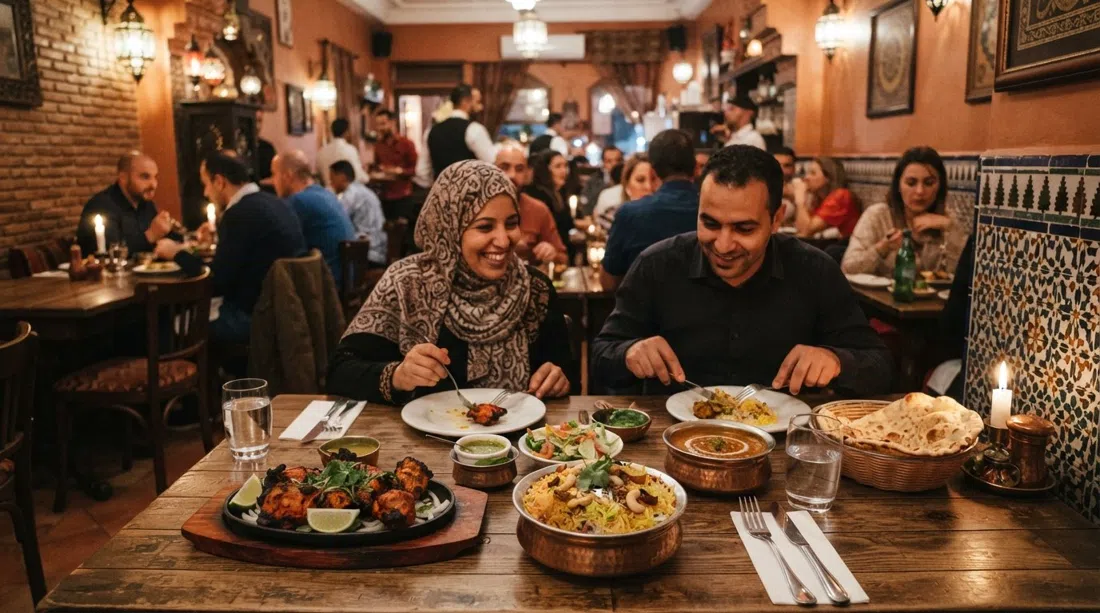
Boulevard Ghandi is the spine of Bourgogne’s sit-down life, a long, busy strip where cafés, restaurants and traffic share the same stage. Clay Oven, at 245 Boulevard Ghandi, has been Casablanca’s dependable Indian restaurant for more than twenty years. Tandoori, biryanis and crisp roti make up the backbone of the menu, with mains in the 50–160 dirham range, and the place is among the city’s highest-ranked kitchens on Tripadvisor. It is not trying to be fashionable. It is trying to be reliable, and in Casablanca that can be its own kind of luxury.
Nearby, Le Bouz at 70 Boulevard Ghandi is the neighbourhood’s broad-shouldered all-rounder: a big modern café-restaurant with a full bar, sushi, and a fusion menu that drifts from Italian to Lebanese. Mains hover roughly between 80 and 150 dirhams. It is one of the few places in the immediate area where you can order a proper drink and stay for a while, which matters in a district that otherwise keeps its evenings relatively domestic.
For breakfast and brunch, Moskova at 108 Boulevard Ghandi opens early for pancakes, crêpes and proper coffee at low prices. It is the sort of place you drop into before the city fully wakes, when the street is still half-soft and the first cups are being poured for people on their way to work. And then there is Venezia Ice, the Moroccan gelato-and-pastry chain with a well-loved Bourgogne branch, good for ice cream, pizza or a late sweet when the day has already run long. None of these places is destination dining. That is the charm. They are the honest, everyday addresses that make staying here feel like living here.
Going out
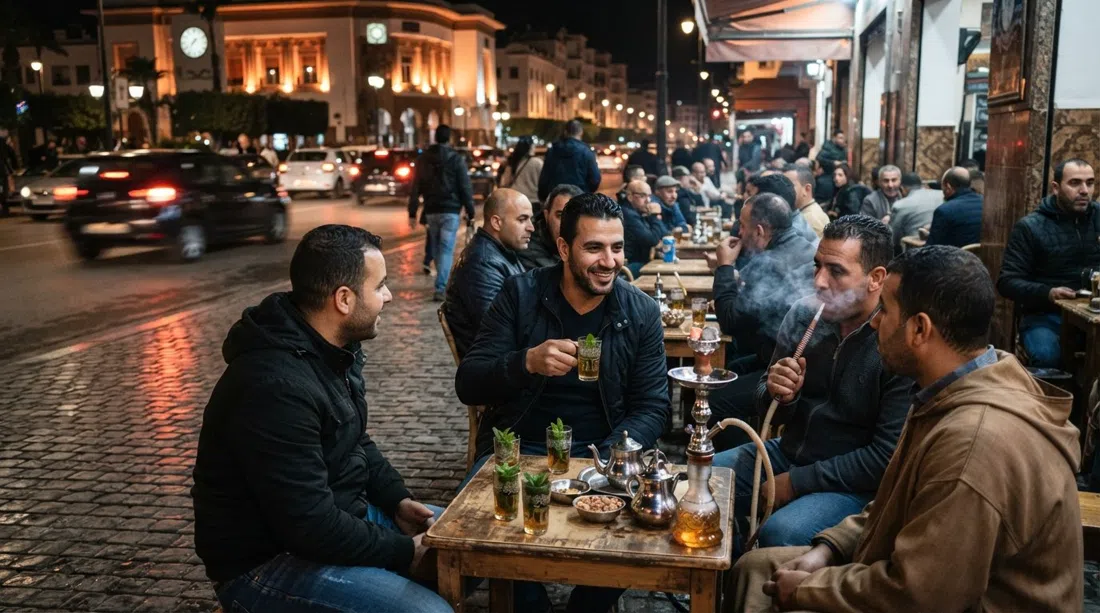
Bourgogne is not a nightlife neighbourhood, and it never pretends to be one. The evening rhythm here is slower and more conversational. Along Boulevard Ghandi, café terraces stay busy well after dark with people nursing mint tea, coffee and shisha, watching the traffic and talking football. That is the local version of going out: social, pavement-based, and unhurried. The boulevard itself does much of the work. Cars pass, cups clink, smoke drifts, and the night settles into a long, ordinary conversation.
Le Bouz is the main exception. Because it has a proper licensed bar and cocktails, it draws a later crowd than most of the neighbourhood’s cafés. If you want to stay within Bourgogne and have an actual drink rather than a tea, this is the address that gives you the option. Beyond that, the district fades into late-night rôtisseries and the odd 24-hour café. It is not a place for clubbing, nor does it need to be.
If the evening calls for more, Bourgogne is well placed to leave. Ain Diab and the Corniche are a ten-minute taxi west along the coast, with beach clubs and bars that take over where Bourgogne leaves off. Gauthier and Racine, across Boulevard d'Anfa, offer the smarter cocktail bars and restaurants. Bourgogne’s role in a night out is the before and the after: dinner, coffee, shisha, the walk home. It is the neighbourhood you return to when you want the city to lower its voice.
Things to do
The reason to base yourself in Bourgogne is not that it is packed with sights. It is that the city’s most important ones are close enough to make the neighbourhood useful. The Hassan II Mosque sits just north of Bourgogne on the Atlantic shore, and from much of the district its minaret is visible above the roofs. It is one of the world’s largest mosques and one of the few in Morocco open to non-Muslims on guided tours. You can walk there in 20 to 30 minutes or take a five-minute taxi. The vast marble courtyard and the sea crashing beneath the glass floor make the trip feel larger than the short distance suggests.
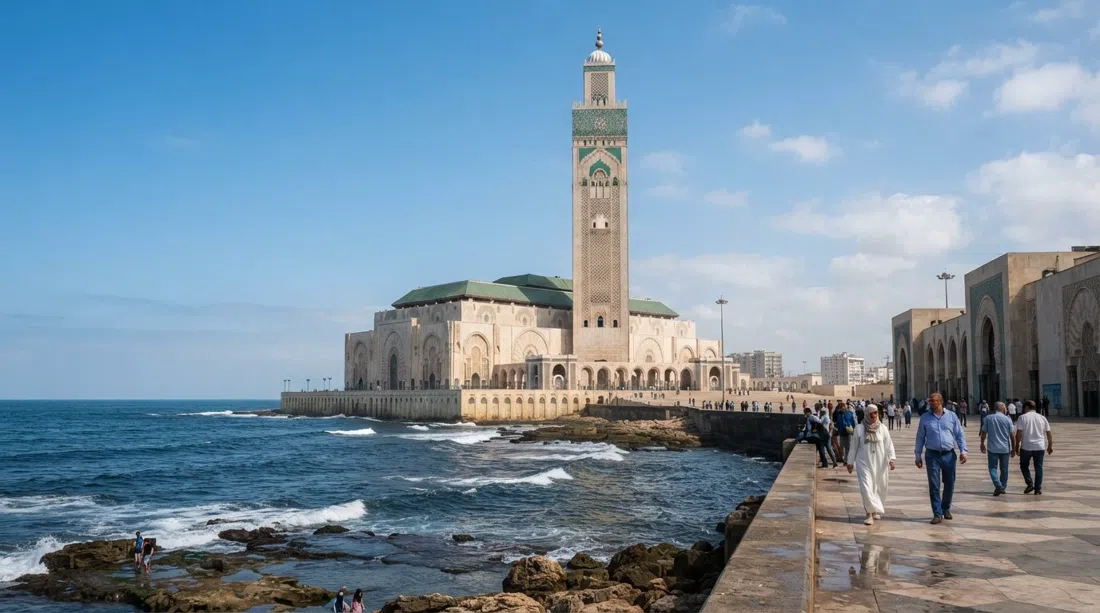
From the mosque, the Casablanca Corniche runs west past rocky coves toward Ain Diab. It is the city’s coastal promenade, and from Bourgogne it is a short walk north before the route opens out into sea air and the long, low sweep of the shore. A little farther along, about two kilometres down the Corniche, stands El Hank Lighthouse, or Phare d'El Hank. Built in 1916 and shaped like an old Moroccan minaret, it rises 51 metres and has a 256-step spiral staircase. Climb it for long views back over the mosque and the coastline, or simply sit at its base and let the sea do the talking.
Closer to home, the pleasure of Bourgogne itself is more modest and, in its way, more revealing. Walk the side streets. Look at the low colonial villas that survive behind the newer residential towers. Notice the Art Deco doorways, the practical shopfronts, the pharmacies and phone shops, the small produce sellers, the corners where people stop without needing a reason. This is a neighbourhood that teaches you Casablanca through repetition rather than spectacle. It is the city’s ordinary life, and that is exactly why it matters.
Shopping
Shopping in Bourgogne is mostly about the useful things first. This is a district thick with the small shops that keep a city running: pharmacies, bakeries, phone and electronics stalls, hardware stores and local produce sellers along the side streets and boulevards. Street markets supply fruit, vegetables and fish the way residents actually buy them. It is not a neighbourhood for browsing boutiques. It is a place to stock a self-catering flat, replace a charger, pick up bread, or buy tomatoes and parsley on the way home.
For something more enclosed and air-conditioned, Ghandi Mall sits on the neighbourhood’s eastern edge on Boulevard Ghandi. It is a modern centre with international and Moroccan brands, everyday stores and food outlets, useful for clothes, electronics or a rainy-afternoon wander. A little further south, the Twin Center has its own shopping levels beneath the towers. And if you want the full mall experience — high-street fashion, cinema, the lot — Anfa Place on the Corniche is a short taxi ride west, with Morocco Mall beyond it. Bourgogne itself keeps retail unglamorous and useful. The corner shop and the market stall are the real addresses here.
Where to stay in Bourgogne
Bourgogne’s accommodation is dominated by apartments, which makes sense in a neighbourhood that is residential first and last. The smart move here is a serviced flat or a room in a small local hotel rather than a big-name property. The payoff is simple: price and position. You can find a comfortable modern apartment within a short walk of the Hassan II Mosque and the sea for a fraction of what a Corniche or Racine hotel charges. For value-minded visitors, that is the whole argument.
The eastern side around Boulevard Ghandi puts you closest to cafés, the mall and the tram, and is the most convenient if you want to move around easily. The northern and western streets, sloping toward El Hank and the coast, get you nearest the mosque and the sea, but they are also denser and scrappier. Expect a mid-range to budget feel, a walk-up apartment building rather than an elevator-and-doorman tower, and a neighbourhood that carries on around you. If you want quiet and polish, look to Gauthier or Anfa. If you want a real Casablanca address near the headline sights for less, Bourgogne is the better bet.
Getting around
Bourgogne’s core is walkable. The café-and-shop grid around Boulevard Ghandi and the residential streets around it are easy enough on foot, and walking is the best way to understand how the neighbourhood fits together. But the district spreads toward the coast, and beyond the immediate core you will lean on taxis. Casablanca’s small red petit taxis are cheap and everywhere, which makes them the easiest way to bridge the short gaps. App-based rides operate too.
The Casablanca tramway clips the neighbourhood as well. The T2 line, which runs to Aïn Diab on the coast, serves stops along Boulevard Bourgogne and Boulevard Ghandi, giving you a clean, cheap ride to the beach one way and toward the city centre the other. Distances from here are short: the Hassan II Mosque is a 20 to 30 minute walk or a five-minute taxi north; the Corniche and Ain Diab are about ten minutes west; Gauthier, Racine and the city centre are a short hop south and east; the medina and Casa-Port train station are ten to fifteen minutes away. Mohammed V International Airport is roughly 30 to 40 minutes by taxi, or reachable by a train connection from Casa-Voyageurs.
That is the quiet advantage of Bourgogne. It trades a beachfront address for a central, well-connected one. Nothing you want to see is far, and the tram and cheap taxis close the gap. In a city as large and restless as Casablanca, that kind of geography is worth more than a view.